

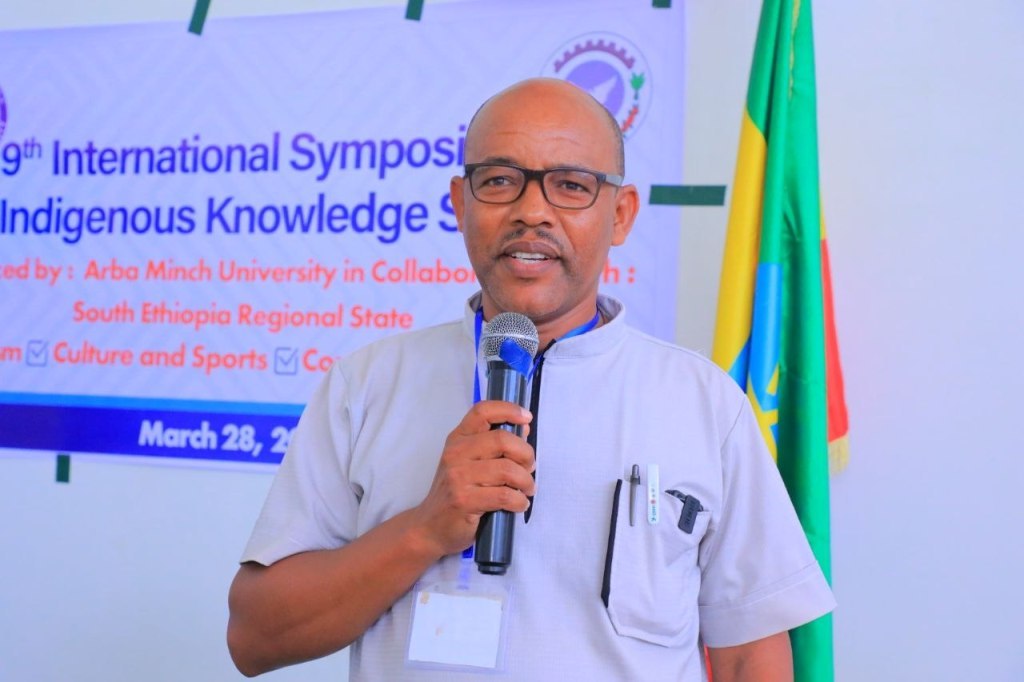
Arba Minch University (AMU), in collaboration with the South Ethiopia Regional State Tourism Bureau, Culture and Sports Bureau, and the Council of Nationalities, hosted the 9th International Symposium on Indigenous Knowledge Studies on March 28, 2026. The symposium brought together researchers from universities across Ethiopia and abroad, representing diverse fields including social sciences and humanities, arts, culture and heritage, healthcare management, pedagogical and behavioral sciences, and law. A total of eight research papers were presented and discussed, and certificates were awarded to presenters and partner institutions. Click here to see more photos.
In his opening remarks, Dr. Teklu Wegayehu, Vice President for Research and Cooperation, emphasized the significance of indigenous knowledge in addressing contemporary global challenges, noting that it offers sustainable solutions to environmental issues, societal conflicts, and broader social problems. He highlighted that indigenous knowledge in Ethiopia is a rich, orally transmitted system encompassing areas such as agriculture, traditional medicine, architecture, and governance, and stressed the importance of systematically documenting it through scientific approaches to preserve cultural heritage and ensure its transmission to future generations. Referring to the symposium, he noted its timeliness, as it coincides with ongoing efforts to register the Gamo people’s “Dubusha” tradition as UNESCO intangible cultural heritage, and reaffirmed the university’s commitment to advancing indigenous knowledge through research and documentation.
Mr. Tariku Ocha, Deputy Head of the South Ethiopia Regional Culture and Sports Bureau, commended AMU for its significant contributions to the region through scientific and knowledge-based research aimed at identifying and documenting diverse forms of indigenous knowledge, including the Gamo “Dubusha” and Derashe “Filla.” He noted that indigenous knowledge, passed down orally through generations via stories, songs, folklore, myths, and lived experiences, encompasses areas such as agriculture, traditional medicine, architecture, and governance, and plays a vital role in promoting sustainable development and community resilience. He further emphasized the importance of strengthening collaboration with universities to better understand the region’s rich cultural values and indigenous knowledge systems, and to utilize them in fostering solidarity, unity, and lasting peace for the future.
Keynote speaker Mr. Abdulfetah Abdulahi, Executive Director of the Buluko Indigenous Knowledge Institute, researcher, and author, emphasized that the proper utilization of indigenous knowledge has been fundamental to the development and prosperity of many nations. He noted that integrating indigenous knowledge with modern science can offer comprehensive solutions in areas such as ecology, agriculture, and healthcare. Highlighting the risk of knowledge loss as elders pass away, he stressed the urgent need for systematic documentation and protection of indigenous knowledge to prevent misappropriation and to respect the rights of its custodians. He further underscored that studying and preserving indigenous knowledge is vital for promoting sustainable development, strengthening democratic systems, advancing tourism, fostering national reconciliation, ensuring justice, and protecting the environment.
Mr. Tafesse Walea, Director of the Institute of Culture and Language Studies at AMU, explained that indigenous knowledge encompasses the unique, localized, and holistic understanding, skills, and philosophies developed by communities over generations. Passed down orally, it guides relationships with nature and supports biodiversity conservation, climate resilience, sustainable agriculture, and ecological stewardship. He noted that the institute is actively engaged in documenting local languages and indigenous knowledge, including efforts to establish a museum to preserve cultural heritage and safeguard endangered languages. Highlighting the significance of the event, Mr. Tafesse added that while eight national symposiums have been held at Jinka and AMU’s main campus, the 9th International Symposium on Indigenous Knowledge Studies is the first to be hosted at Chamo Campus.
One of the presenters, Mr. Mieraf Tekle, co-founder, board member, and instructor at Jazz Amba School of Music, highlighted the polyphonies of the Gamo people, one of the rarest and most esteemed musical textures, characterized by the simultaneous performance of multiple melodies.
Invited guests from South Ethiopia regional bureaus, presenters from various universities and institutes, and AMU staff from the Colleges of Social Sciences and Humanities, Business and Economics, the School of Pedagogical and Behavioral Sciences, and the School of Law attended the symposium. Dr. Tesfaye Habtemariam, AMU Research Director, mastered the ceremony.
For more Information Follow us on:-
Website - https://www.amu.edu.et/
Telegram - https://t.me/arbaminch_university
Facebook - https://www.facebook.com/ArbaMinchUniversityccd/
YouTube - https://www.youtube.com/channel/UCOO_nclhMo8M3r74OyPBlVA
Public and International Relations Executive