

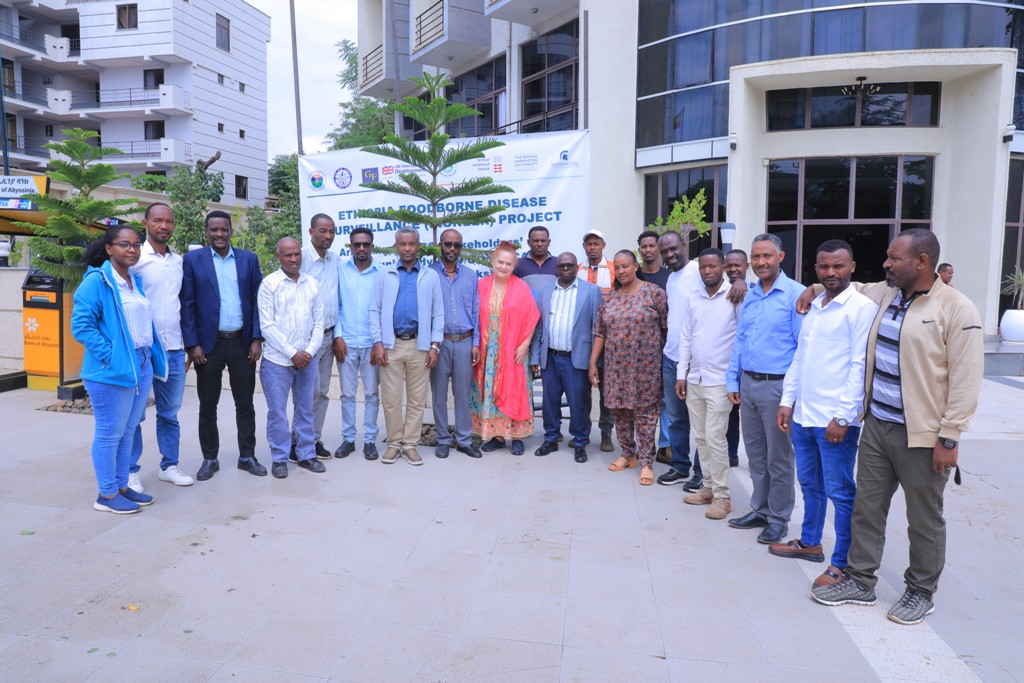
Arba Minch University (AMU) and Haramaya University (HU), in collaboration with the Ethiopia Food-borne Disease Surveillance (PIONEER) Project, hosted a sensitization workshop aimed at improving food safety and public health in Ethiopia. The workshop brought together stakeholders of the Arba Minch Health and Demographic Surveillance System (HDSS) and members of the Community Advisory Group (CAG) on March 6, 2026, at Daros International Hotel in Arba Minch. Click here to see more photos.
Dr. Zerihun Zerdo, Research Corporate Director and the delegate for the Chief Executive Director of College of Medicine and Health Sciences (CMHS) at AMU, highlighted that the true burden of food-borne diseases in Ethiopia is largely unknown, posing a significant public health challenge. He explained that current surveillance relies on passive reporting and often fails to identify the pathogens or contaminated food sources, limiting evidence for effective interventions. The Ethiopia Food-borne Disease Surveillance (PIONEER) Project aims to address this by raising stakeholder awareness, fostering cross-sector collaboration, and establishing an integrated surveillance system using existing platforms such as the Arba Minch Health and Demographic Surveillance System (HDSS). The project will collect data on infectious and chemical contaminants, including aflatoxins and heavy metals, linking exposures to health outcomes. Adopting a One Health approach, it brings together health, agriculture, and regulatory sectors, as well as academic institutions, local administrations, and communities, emphasizing that strong collaboration and community engagement are essential for effective prevention and control.
Ms. Bange Banse, Deputy Director of the Gamo Zone Health Department, highlighted that food-borne diseases remain a major global public health concern. She noted that millions of people worldwide suffer from food-borne illnesses each year, with studies indicating that more than 420,000 deaths occur annually due to food-borne diseases. She explained that food contamination can occur at various stages, including handling, preparation, and storage, often caused by different microorganisms. She added that the workshop aimed to provide a platform for stakeholders to exchange ideas and discuss ongoing research and analytical efforts aimed at preventing and controlling food-borne diseases.
Dr. Desalegn Admasu, a researcher at HU and Project Coordinator, noted that the project has established surveillance activities in four selected sites across the country to help prevent food-borne diseases, with AMU serving as one of the key sites. He explained that food-borne diseases pose a significant burden in Ethiopia, affecting public health and placing pressure on the country’s economy. Dr. Desalegn further stated that samples and data from raw and cooked foods, as well as from animals and animal waste, will be collected in the selected locations to generate evidence that can support effective prevention and control efforts.
Dr. Mergia Deresa, a maternal and child health researcher at HU and a member of the project, stated that the initiative is currently being implemented in selected sites including Hararge, Debre Birhan, Butajira, and Arba Minch to assess the prevalence and severity of food-borne diseases in Ethiopia and to develop evidence-based solutions. He added that the workshop would help guide stakeholders in fulfilling their roles in preventing food-borne diseases, particularly by promoting improved food handling practices, hygiene, and environmental protection.
The workshop covered key topics, including the objectives of the Ethiopia Food-borne Disease Surveillance (PIONEER) Project, the distribution and impact of food-borne diseases in Ethiopia and globally, project sites, clinical data collection, and sample handling and testing procedures. Participants also discussed the roles of stakeholders across the farm-to-table chain in ensuring food safety and preventing food-borne diseases. Attendees included staff from Haramaya University, Gamo Zone Health Department, the Agriculture Department, heads of Arba Minch Town Health Department, the Food and Drug Regulation Authority, local administrations, academic and research institutions, and representatives from local communities.
For more Information Follow us on:-
Website - https://www.amu.edu.et/
Telegram - https://t.me/arbaminch_university
Facebook - https://www.facebook.com/ArbaMinchUniversityccd/
YouTube - https://www.youtube.com/channel/UCOO_nclhMo8M3r74OyPBlVA
Public and International Relations Executive