

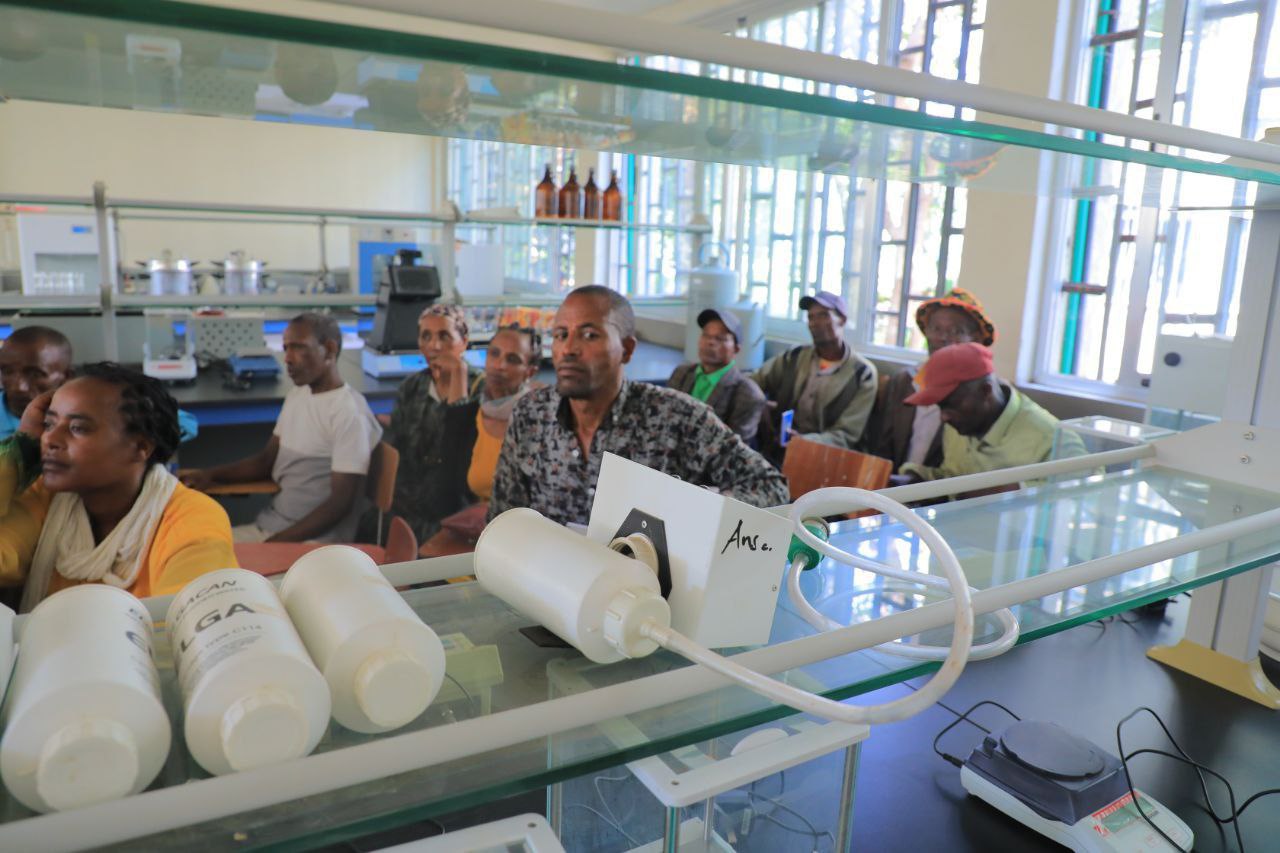
Arba Minch University (AMU), through its AMU–IUC Project (Sub-project V), has conducted a Training of Trainers (ToT) program aimed at enhancing Enset production, improving livestock feed systems, and promoting sustainable agricultural productivity in Gamo Zone.Click here to see more photos.
The three-day training was held from January 28–30, 2026, at the College of Agricultural Sciences of Arba Minch University, and brought together selected model farmers and agricultural experts from seven woredas of the Zone.
Speaking at the closing ceremony, Dr. Teklu Wegayehu, Vice President for Research and Cooperation of Arba Minch University and Coordinator of the AMU-IUC Project, underscored that agriculture remains the backbone of Ethiopia’s economy. He noted that Agricultural Sciences is one of the University’s priority focus areas and emphasized that Enset has become a key research and development focus for AMU. He added that, due to sustained research efforts, Enset has now been integrated into the national agricultural extension package of the Ministry of Agriculture.
Dr. Fassil Eshetu, AMU–IUC Project Manager, stated that the project aims to translate research outputs into practical solutions that can be directly applied at the grassroots level. He explained that the project places strong emphasis on capacity building, knowledge transfer, and continuous follow-up to ensure effective application of research-based technologies by farmers and extension professionals.
Professor Yishak Kechero, AMU–IUC Project V Leader, Director of the School of Graduate Studies, and one of the lead trainers, explained that the sub project focuses on enhancing livestock and crop production and productivity while promoting sustainable land use management. He noted that the training was organized to transfer best research-based practices to farmers and key stakeholders, with the objective of ensuring sustainable Enset production and strengthening livestock feed security.
He further stated that his training sessions focused on improved livestock feed production, processing, and utilization, including the formulation of balanced animal feed. According to Professor Yishak, applying these research-based feed technologies is critical for improving livestock productivity, reducing feed shortages, and supporting sustainable livestock-based livelihoods.
The Dean of the College of Agricultural Sciences, Dr. Degife Assefa, noted that the training contents were drawn from long-term, scientifically validated research conducted by the project team. He encouraged participants to actively apply the knowledge gained and disseminate the improved practices within their respective communities.
Among the trainers, Dr. Gezahagn Garo, a lecturer and researcher in the Department of Horticulture, delivered training focused on improving Enset productivity. His sessions covered farmer-level preparation and multiplication of clean and disease free Enset planting materials, proper crop management practices, and compost preparation and utilization techniques.
Dr. Sabura Shara provided training on Enset Bacterial Wilt, highlighting disease symptoms, modes of transmission, risk factors, and prevention and control measures. He emphasized the importance of early detection and the integration of farmers’ indigenous knowledge with scientific research findings to effectively manage the disease.
Dr. Ashenafi Azage, an animal nutrition researcher and trainer, provided hands-on training on improved livestock feed preservation techniques, with a strong focus on silage preparation. He explained that milk production in Ethiopia can decline by up to 35 percent during hot seasons, mainly due to feed shortages and poor-quality fodder. Dr. Ashenafi emphasized that silage is a vital solution during periods of feed scarcity, as it helps minimize production losses, stabilize milk yield, and sustain overall livestock productivity.
Participants expressed strong appreciation for the training. Meseret Wolde, a participant from Chencha Zuria Woreda, said the training significantly improved her understanding of Enset management, clean planting material multiplication, and disease prevention methods. She pledged to share the knowledge with farmers in her locality.
Similarly, Petros Tunge from Boreda Woreda noted that the training enhanced his understanding of Enset disease management, livestock feed preparation, and improved feeding practices.
The Training of Trainers program is expected to contribute significantly to strengthening Enset-based farming systems, improving livestock feed security, and promoting sustainable agricultural development in Gamo Zone.
For more Information Follow us on:-
Website - https://www.amu.edu.et/
Telegram - https://t.me/arbaminch_university
Facebook - https://www.facebook.com/ArbaMinchUniversityccd/
YouTube - https://www.youtube.com/channel/UCOO_nclhMo8M3r74OyPBlVA
Public and International Relations Executive