


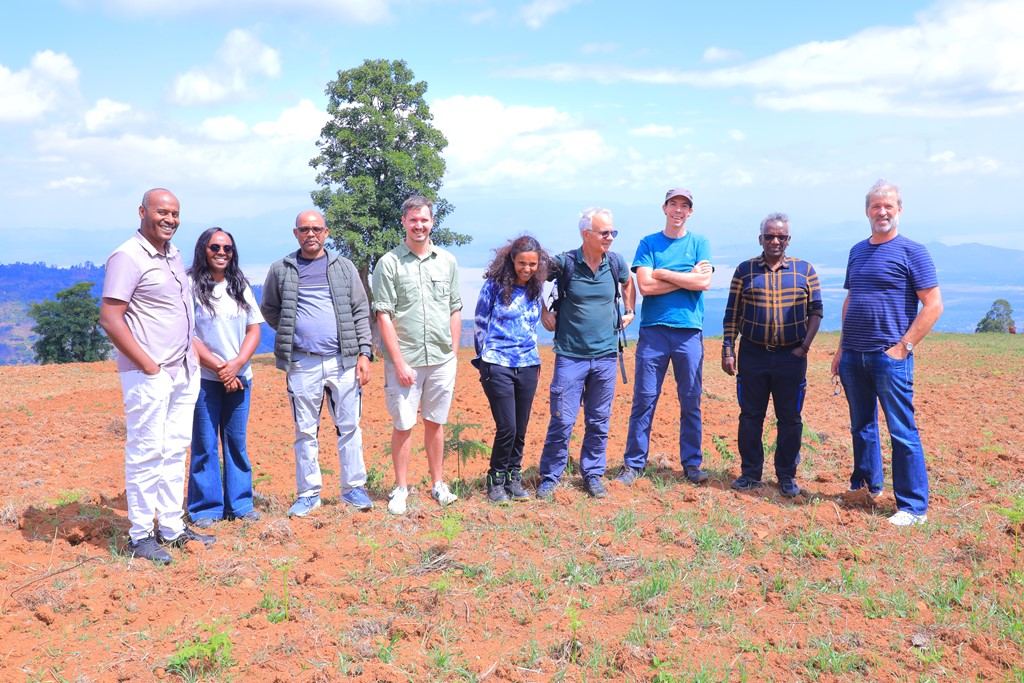
Arba Minch University (AMU), through the AMU-IUC Project, conducted a field visit to a gully rehabilitation demonstration site in Layo Terga Kebele, Mirab Abaya Woreda, showcasing practical approaches to restoring degraded land, protecting agricultural productivity, and reducing erosion and sedimentation risks to downstream water bodies. Click here to see more photos.
The field visit brought together AMU leaders, researchers, project representatives, local government officials, farmers, and international partners to assess the rehabilitation activities and discuss their potential for wider application.
Dr. Teklu Wogayhu, AMU Vice President for Research and Cooperation, described the work under Sub-Project 4 as promising, highlighting the importance of collaboration between the university and farmers in addressing land degradation. He emphasized that the knowledge and practices developed through the intervention should be preserved and continued beyond the project period. He identified scaling up successful interventions as an important agenda. He stressed the need to complement land restoration with livelihood diversification, including livestock production, poultry, beekeeping, and weaving, particularly in the face of increasing population pressure on land resources.
Dr. Fassil Eshetu, AMU-IUC Project Manager, emphasized the AMU-IUC Project’s approach of connecting PhD research with real community problems. He explained that Sub-Project 4 focuses on reversing land degradation through locally adapted solutions that combine scientific knowledge, indigenous knowledge, and locally available materials. He highlighted the role of demonstration sites in translating research into practical action, noting that farmer commitment, seed funding and baseline information provide a foundation for the interventions, while collaboration with government institutions is essential for sustaining and applying successful practices.
Dr. Liulseged Beleynhe, AMU lecturer, researcher and Gully Rehabilitation Outreach Coordinator, explained that AMU’s research across the Shafe, Baso, Sile and Elgo watersheds, covering about 1,000 km², has documented 7,336 gullies and 410 landslides using satellite imagery, field surveys and drone technology. He noted that nearly half of the mapped gullies are located in the Shafe watershed, which drains toward Lake Abaya, making the catchment a priority for rehabilitation. He emphasized that addressing gully erosion in these watersheds is important not only for protecting farmland and communities but also for reducing the movement of soil and sediment toward Lake Abaya.
He said in Layo Terga site, eighteen stone check dams have been constructed using locally available materials, and drone-based monitoring has already recorded encouraging results in reducing gully erosion and retaining sediment. Three additional approaches—sandbag-and-stone, brushwood-and-sandbag, and bamboo-and-brushwood structures—are also being tested to compare their effectiveness, cost, and durability. About 25 affected households are directly involved in planning, construction and monitoring, strengthening community ownership of the rehabilitation work.
Professor Mathieu, a project sub-leader specializing in land degradation and sustainable land management, said he has been visiting the Shafe catchment for about 10 years and has witnessed the extent of land degradation in the area. He noted that farmers had already been undertaking small-scale gully rehabilitation and soil and water conservation measures, including check dams and stone bunds, and that the AMU-IUC Project has supported the upscaling of these efforts through the demonstration site. He encouraged farmers to learn from the demonstration and select appropriate measures according to their local conditions and available materials, while emphasizing the importance of maintaining the site as a long-term learning and training platform.
Wogene Walelu, Deputy Head of the Mirab Abaya Woreda Agriculture Office, described soil erosion and gully formation as major challenges in the area. He said the demonstration site provides an important opportunity for farmers and agricultural professionals to observe practical gully rehabilitation measures and apply the lessons in other severely degraded areas.
Bogale Kebede, a farmer, recalled the severity of soil erosion in the area and said soil and water conservation activities have contributed to improved agricultural production. He noted that farmers who have seen the results are increasingly sharing and applying similar practices on their own land, while identifying shortages of construction materials and labor as continuing challenges.
Daniel Tero, Head Administrator of Layo Terga Kebele, said the rehabilitation activities have brought visible benefits to the community. He noted that farmers are increasingly adopting the practices and making better use of rehabilitated areas for crop production and livestock feed. He called for continued support to sustain the benefits and further strengthen community-based rehabilitation efforts.
In addition to the Layo Terga demonstration site, the field visit team also visited sustainable land management initiatives supported through the KfW project, which is implementing interventions across 10 woredas in the Lake Chamo watershed.
For more information, follow us on:-
Website - https://www.amu.edu.et/
Telegram - https://t.me/arbaminch_university
Facebook https://www.facebook.com/ArbaMinchUniversityCAD/
YouTube - https://www.youtube.com/channel/UCOO_nclhMo8M3r74OyPBlVA
Public and International Relations Executive