

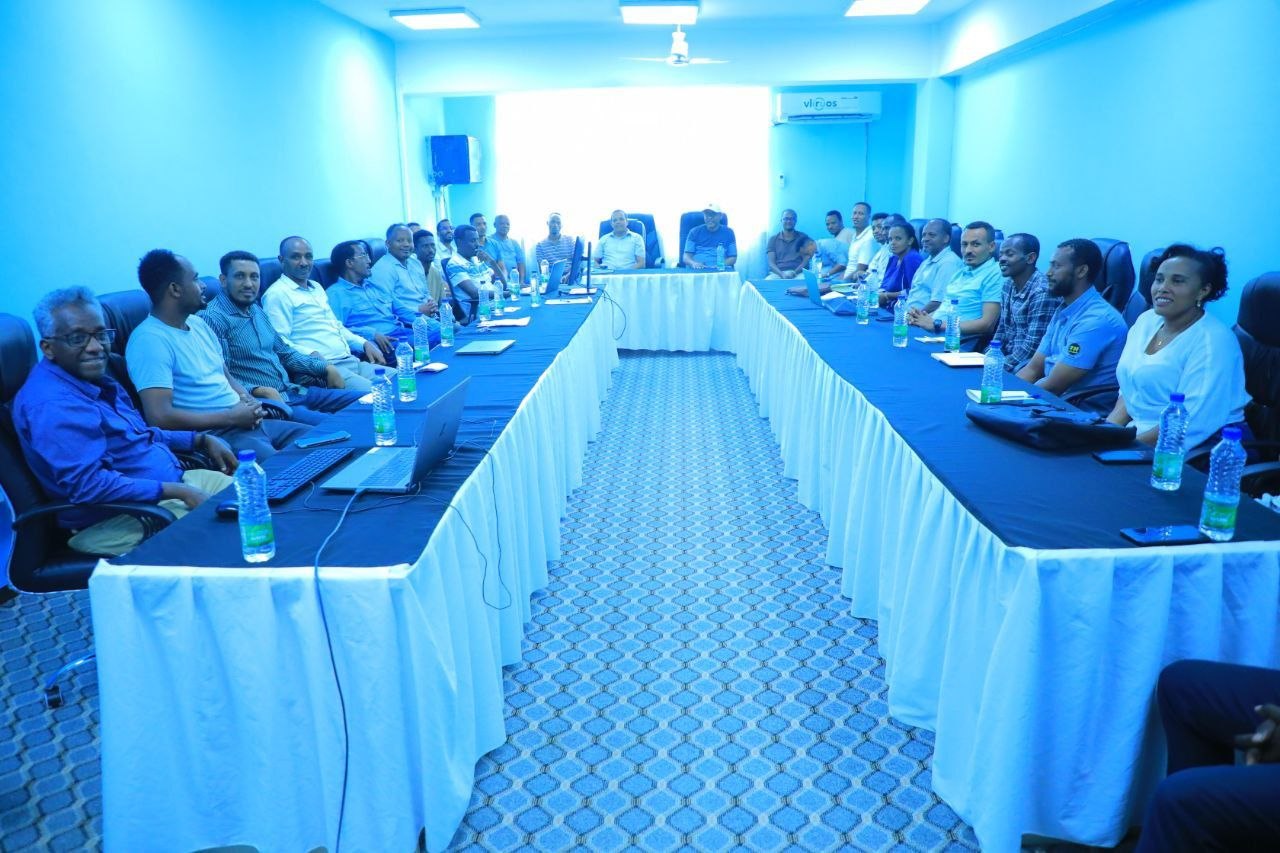
Arba Minch University (AMU) has launched the second year of monitoring and data collection for the Sustainable Land Management Program Phase V (SLM-V), a joint project between AMU and the Ministry of Agriculture (MoA), supported by KfW funding, in the Lake Chamo watershed. The initiative aims to assess progress in watershed restoration, evaluate environmental changes, and measure the project's impacts on community livelihoods. Click here to see more photos.
The comprehensive baseline study conducted by AMU last year covered 327 households and 422 biophysical plots across seven woredas, including 199 treatment households and 242 treatment plots within 16 intervention micro-watersheds. It established reference data on land conditions, soil and carbon stocks, water resources, biodiversity, agricultural productivity and household livelihoods.
AMU President Dr.-Ing. Abdella Kemal, who provides strategic leadership for the University's engagement in the project, emphasized that the initiative strengthens the University's research capacity through state-of-the-art research equipment, advanced technologies, and specialized laboratory facilities. He noted that the project supports two of the University's core missions—research and community service—while strengthening local communities through sustainable land management, improved livelihoods, and the protection of Lake Chamo. He reaffirmed the University's commitment to providing institutional support and working closely with stakeholders to ensure successful implementation. He also underscored that the project's success would enhance the University's reputation and visibility nationally and internationally.
Dr. Teklu Wegayehu, AMU Vice President for Research and Cooperation and the University's focal person for the project, highlighted the multidisciplinary nature of the initiative, which involves nearly all university colleges, schools, and research institutions. He explained that the project is strengthening research infrastructure through specialized laboratories and advanced technologies, including HydroDrone, automatic weather stations, and river-gauging stations. These facilities are expected to expand integrated environmental research, scientific investigation, and monitoring capacity.
Presenting the project's research and monitoring framework, Dr. Fasil Eshetu, Project Manager, emphasized the importance of comparing newly collected data with baseline records to measure achievements, identify gaps, and guide future interventions. He also highlighted the project's spatial accountability framework, which uses unique household and biophysical plot identification numbers to track interventions and measure changes at specific locations over time.
Dr. Fasil further explained that the monitoring will examine changes in soil erosion, vegetation cover, agricultural productivity, food security, household income and the adoption of sustainable land-management practices. He stressed that data quality is fundamental to the project's overall success, urging data collectors to demonstrate accuracy, responsibility and professionalism to ensure reliable findings and informed decision-making.
Dr. Mesfin Tilahun, Project Advisor, highlighted the seven thematic areas of the second-year monitoring: land condition, soil and carbon, water resources, biodiversity, household livelihoods, institutional performance, and landslide-prone areas and related environmental hazards. He noted that the assessment of landslide-prone areas is a newly introduced component designed to identify vulnerable locations, assess environmental risks, and inform appropriate risk-reduction interventions.
The project extends across approximately ten vulnerable districts, including seven in the Gamo Zone, addressing interconnected environmental and socio-economic challenges through research, community engagement, land rehabilitation and institutional capacity building.
At the conclusion of the launch, project team leaders and data collectors expressed their commitment to working collaboratively and carrying out the monitoring activities with professionalism, accountability, and due attention to data quality to ensure reliable findings and successful project implementation.
Arba Minch University
Spring of Wisdom!
For more information, follow us on:-
Website - https://www.amu.edu.et/
Telegram - https://t.me/arbaminch_university
Facebook - https://www.facebook.com/ArbaMinchUniversityccd/
YouTube - https://www.youtube.com/channel/UCOO_nclhMo8M3r74OyPBlVA
Public and International Relations Executive