

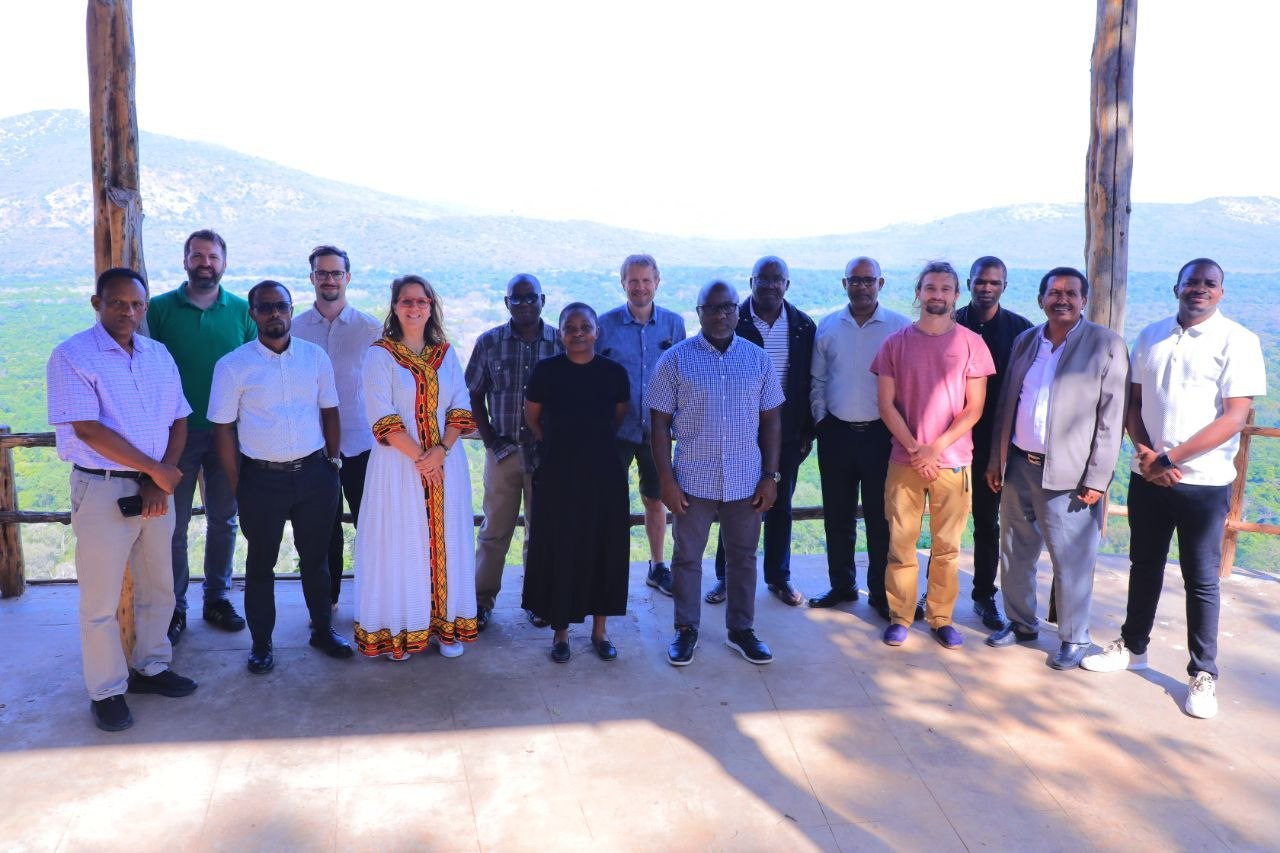
ARBA MINCH, Ethiopia – August 10, 2026 — The RUNRES Project has concluded its closing workshop in Arba Minch, marking seven years of international collaboration to develop circular bio-economy solutions that transform waste and agricultural resources into valuable products, create livelihoods, and strengthen sustainable food systems.Click here to see more photos.
Held at Paradise Lodge, Arba Minch, the closing workshop brought together project partners from Ethiopia, South Africa, Rwanda, the Democratic Republic of the Congo (DRC), and Switzerland to review achievements from the two project phases, share experiences, and discuss strategies for sustaining the innovations beyond the project period.
Dr.-Ing. Abdella Kemal, President of Arba Minch University, expressed his appreciation to the RUNRES partners for their strong collaboration and contributions throughout the seven-year project.
Dr.-Ing. Abdella noted that the collaboration established through RUNRES will continue beyond the completion of the project. He affirmed AMU's commitment to ensuring that the university continues the endeavors initiated through RUNRES and works to sustain and further develop the project's achievements.
Dr. Teklu Wegayehu, Vice President for Research and Cooperation of Arba Minch University and Co-Principal Investigator of the RUNRES Project, emphasized the importance of collaboration in translating research and innovation into practical solutions for communities.
He highlighted the need to sustain the partnerships, knowledge, and innovations developed through RUNRES beyond the project's funding period and reaffirmed AMU's commitment to continued engagement with local stakeholders and partners.
Dr. Teklu also emphasized Arba Minch University's significant achievements under the RUNRES Project, particularly the successful development and demonstration of practical innovations in municipal solid organic waste recycling and banana value addition. He noted that these innovations have contributed to improved livelihoods, food security, and environmental and human health in city-region food systems through the implementation and scaling of innovations for circular food value chains.
AMU is also working to institutionalize circular bio-economy practices through its academic and community-service activities and plans to establish a Center of Excellence for Circular Economy to support training, research, innovation, and future initiatives.
Professor Johan Six, Principal Investigator and Coordinator of the RUNRES Project from ETH Zurich, described the overall implementation across the participating countries as successful.
He noted that while some innovations tested during the first phase did not produce the expected results, successful approaches were further developed during the second phase.
Professor Six highlighted the project's interdisciplinary and Trans disciplinary approach, which brought researchers together with local stakeholders to develop practical solutions. He particularly praised AMU's commitment to stakeholder engagement and implementation.
“Our local collaborators at Arba Minch University were exceptionally committed,” Professor Six said, recognizing the team's efforts to ensure that innovations were properly implemented on the ground.
According to Mr. Abayneh Feyso, RUNRES Project Manager at Arba Minch University, Ethiopia emerged as one of the strong-performing countries in practical implementation and scaling.
Key achievements include processing green bananas into nutritious banana flour and other value-added products, helping reduce post-harvest losses, and converting municipal organic waste into high-quality compost for agricultural use.
The composting innovation was also expanded to Birbir town, supported by waste-handling machinery and local enterprise development.
Mr. Abayneh explained that the Ethiopian model operates through a Public–Private Partnership involving AMU, government and municipal institutions, and private micro-enterprises.
Professor Alfred Odindo of the University of KwaZulu-Natal, South Africa, described RUNRES as the culmination of seven years of collaborative work addressing waste management, agro-processing, environmental protection, and livelihood improvement.
He particularly commended Ethiopia's green banana processing and municipal solid organic waste recycling highlighting their contribution to employment, food production, and organic compost production.
Mr. Abdow Konlambigue, Senior Agribusiness Specialist at the International Institute of Tropical Agriculture (IITA), highlighted Rwanda's innovations, including Black Soldier Fly Larvae (BSFL) as an alternative protein source for animal feed and High-Quality Cassava Peel (HQCP) flour as a substitute for maize.
He emphasized the need for continued business support, quality assurance, networking, and documentation to sustain and scale these circular bio-economy enterprises.
As part of the closing ceremony, Arba Minch University presented special crystal awards to Professor Johan Six and the Swiss Agency for Development and Cooperation (SDC) in recognition of their valuable contributions and support to the RUNRES Project.
Arba Minch University
Spring of Wisdom!
For more Information Follow us on:-
Website - https://www.amu.edu.et/
Telegram - https://t.me/arbaminch_university
Facebook - https://www.facebook.com/ArbaMinchUniversityccd/
YouTube - https://www.youtube.com/channel/UCOO_nclhMo8M3r74OyPBlVA
Public and International Relations Executive